

1099-MISC Vs. 1099-NEC:
Compare 19 Key Aspects
When it comes to tax reporting, understanding 1099-MISC vs. 1099-NEC is crucial for freelancers, contractors, and businesses. Both forms report income, but they serve different purposes. Confusing the two can lead to errors in filing and potential penalties from the IRS.
The 1099-MISC is used for reporting miscellaneous income, such as rent, royalties, and awards. On the other hand, the 1099-NEC specifically reports non-employee compensation, like payments to independent contractors for services rendered. Let’s explore the key distinctions and when to use each form.
Estimate your federal income tax in seconds
Enter your income and filing status in our free Federal Income Tax Calculator to see your bracket, tax and take-home pay.
What Is 1099-MISC?
Form 1099-MISC is an Internal Revenue Service (IRS) form used to report various types of miscellaneous income payments made by a business to individuals or other entities. This includes payments for things like:
- Rent
- Prizes and awards
- Other income payments
- Medical and healthcare payments
- Crop insurance proceeds
- Attorney fees
Starting with the 2020 tax year, nonemployee compensation for independent contractors, freelancers, sole proprietors, and self-employed individuals is now reported on Form 1099-NEC (Nonemployee Compensation) instead of Form 1099-MISC.
If you received a Form 1099-MISC, it means the payer reported making certain payments to you during the year. You’ll need to include this income on your tax return, and you can estimate your federal income tax to see how it affects what you owe.
Key Points:
- Non-Employee Compensation: Used to report payments over $600 made to freelancers or contractors.
- For Businesses: Required for businesses that hire non-employees for services.
- IRS Reporting: A copy goes to both the contractor and the IRS to report income for tax purposes.
What Is 1099-NEC?
Form 1099-NEC is used to report nonemployee compensation payments to independent contractors or freelancers. This means it’s used for payments made to individuals who perform services for a business but are not considered employees.
Here are some examples of payments that would typically be reported on Form 1099-NEC:
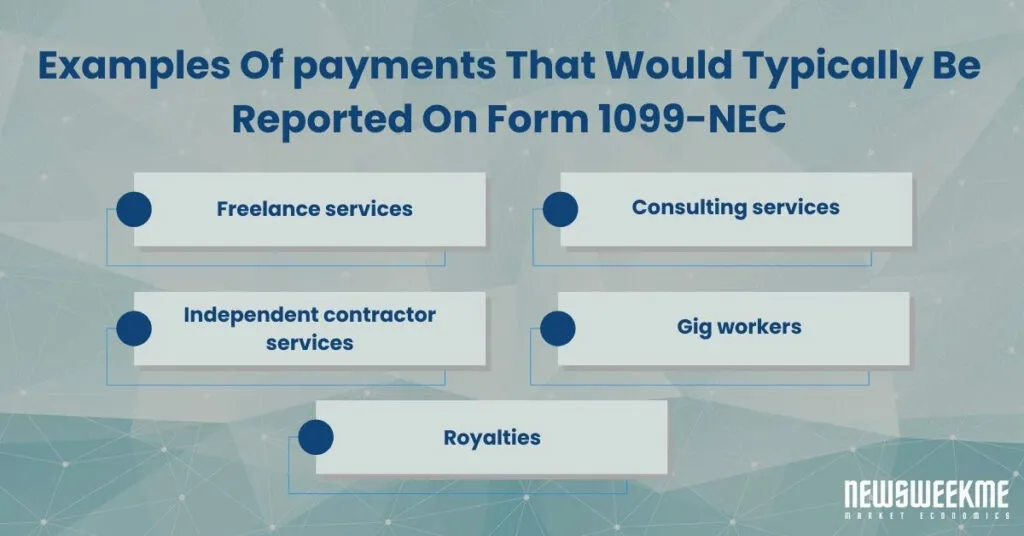
- Freelance services
- Consulting services
- Independent contractor services
- Gig workers
- Royalties
The IRS started using the 1099-NEC form in 2020. Before that, businesses used the 1099-MISC form for these payments. The IRS changed this to keep track of payments better.
You need to give a copy of the 1099-NEC form to the contractor. You send a copy to the IRS. This helps the contractor report income on taxes.
Key points:
- Nonemployee Compensation: This form specifically reports payments made to individuals who are not employees.
- $600 Threshold: Businesses are generally required to file a 1099-NEC if they paid an independent contractor $600 or more during the tax year.
- Reporting Requirements: The form includes information about the recipient’s name, address, and Social Security number, as well as the total amount paid.
1099-MISC Vs. 1099-NEC
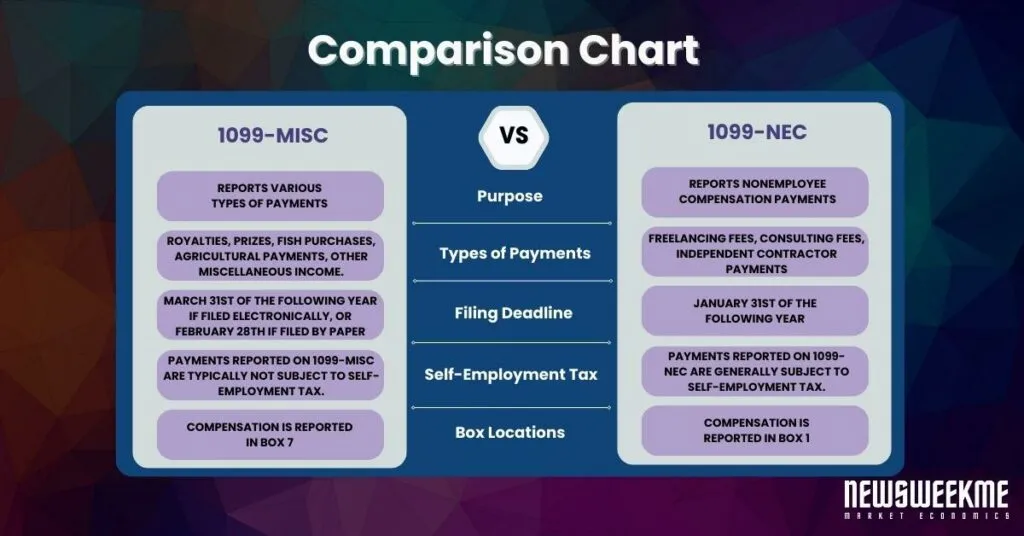
The IRS introduced the 1099-NEC in 2020 to streamline the reporting of non-employee compensation, which was previously reported on the 1099-MISC. While both forms are used to report various types of income, they serve different purposes.
Here’s a comparison table highlighting key differences between these two forms:-
| Aspects | 1099-MISC | 1099-NEC |
| Purpose | 1099-MISC covers miscellaneous income like rent or royalties. | 1099-NEC is used for non-employee compensation |
| Common Types of Payments | Royalties, prizes, fish purchases, agricultural payments, other miscellaneous income. | Freelancing fees, consulting fees, independent contractor payments. |
| Filing Deadline | Generally due on March 31st of the following year if filed electronically, or February 28th if filed by paper. | January 31st of the following year. |
| Self-Employment Tax | Payments reported on 1099-MISC are typically not subject to self-employment tax. | Payments reported on 1099-NEC are generally subject to self-employment tax. |
| Box Locations | Compensation is reported in Box 7. | Compensation is reported in Box 1. |
| Filing Requirement | Generally, required for payments to nonemployees exceeding $600 during the calendar year. | Generally, required for payments to independent contractors or freelancers exceeding $600 during the calendar year. |
| Information Reported | Total amount paid, federal income tax withheld, and other relevant details depending on the type of payment. | Total nonemployee compensation paid, federal income tax withheld. |
| Applicable Tax Forms | Schedule C, Schedule SE (for self-employment tax). | Schedule C, Schedule SE (for self-employment tax). |
| Recipient’s Tax Reporting | Recipient reports income on Schedule C and pays self-employment tax. | Recipient reports income on Schedule C and pays self-employment tax. |
| Applicable Tax Rates | Self-employment tax rate applies to net earnings from self-employment. | Self-employment tax rate applies to net earnings from self-employment. |
| Estimated Tax Payments | Recipients may need to make estimated tax payments throughout the year. | Recipients may need to make estimated tax payments throughout the year. |
| Withholding Requirements | Generally, no federal income tax withholding is required. | Generally, no federal income tax withholding is required. |
| State and Local Taxes | State and local income taxes may apply, depending on the recipient’s location. | State and local income taxes may apply, depending on the recipient’s location. |
| Information Return | Form 1099-MISC is also an information return for the IRS. | Form 1099-NEC is also an information return for the IRS. |
| Copy Distribution | Recipient receives a copy (Form 1099-MISC or 1099-NEC). | Recipient receives a copy (Form 1099-MISC or 1099-NEC). |
| IRS Filing | Sender files a copy with the IRS. | Sender files a copy with the IRS. |
| State Filing | Some states may require filing of state-specific forms. | Some states may require filing of state-specific forms. |
| Electronic Filing | Electronic filing is generally available. | Electronic filing is generally available. |
| Penalties for Non-Compliance | Late filing or incorrect reporting can result in penalties and interest. | Late filing or incorrect reporting can result in penalties and interest. |
Conclusion
Knowing the difference between the 1099-MISC and 1099-NEC helps you stay on top of your taxes. If you’re a freelancer or contractor, you’ll get a 1099-NEC for your work. For rent or royalty income, expect a 1099-MISC.
Using the right form makes tax filing easier and keeps you out of trouble with the IRS. Keep records of your payments and file the correct form. This keeps your taxes simple and stress-free.
It’s important for anyone who works with various incomes to understand these forms. By using the right form, you avoid mistakes and stay organized at tax time. Take control of your finances and know your forms!