

Annual Gift Exclusion Vs. Lifetime Exclusion:
13 Key Aspects
Understanding the annual gift exclusion vs. lifetime exclusion is crucial for individuals looking to optimize wealth transfer and minimize taxes. These tools are vital in estate planning. They let high-net-worth individuals pass on assets while reducing estate taxes.
If you plan for your family’s future or advise clients, use these exclusions wisely. They can help preserve wealth and reduce taxes over time. Let’s explore how these exclusions work and who benefits most from them.
Estimate your federal income tax in seconds
Enter your income and filing status in our free Federal Income Tax Calculator to see your bracket, tax and take-home pay.
What Is Annual Gift Exclusion?
The annual gift exclusion allows individuals to gift a certain amount of money or assets to others each year without incurring a federal gift tax. As of 2026, the exclusion limit is $19,000 per recipient.
Gifts within this limit do not count toward the donor’s Lifetime Exclusion. This exclusion is a valuable tool in estate planning, enabling high-net-worth individuals to gradually transfer wealth while minimizing tax liabilities and reducing the taxable estate over time.
Key Points:
- Tax-Free Limit: You can give up to $19,000 per person per year without triggering the gift tax.
- Unlimited Recipients: You can give gifts to as many individuals as you like.
- No Impact on Lifetime Exclusion: Gifts within the annual exclusion do not count against your lifetime exclusion.
What Is Lifetime Exclusion?
Lifetime exclusion refers to the total number of assets an individual can transfer, either through gifts or their estate, without incurring federal estate or gift taxes.
As of 2026, the exclusion is $15 million per individual. Any gifts or transfers beyond this limit are subject to federal taxes.
The Lifetime Exclusion works with the annual gift exclusion, strategically allowing people to reduce their taxable estate over their lifetime.
Key points:
- Purpose: To allow individuals to transfer wealth to beneficiaries without incurring gift tax.
- Reporting: Gifts exceeding the annual gift exclusion must be reported on Form 709.
- Estate Planning: This can be used to reduce your taxable estate and potentially avoid estate tax.
Key Differences Between Annual Gift Exclusion vs. Lifetime Exclusion
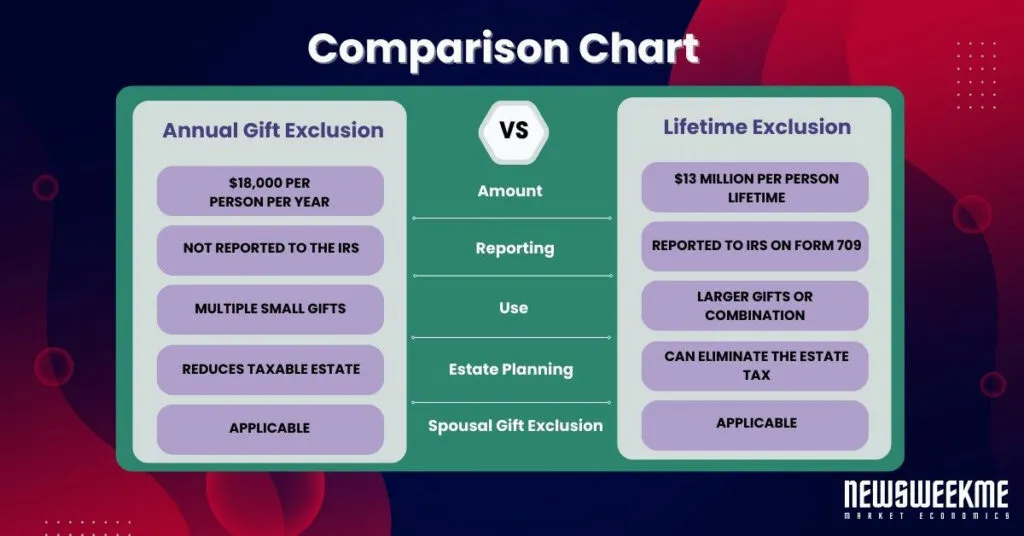
Here are the key differences between the annual gift exclusion and the lifetime exclusion.
| Aspects | Annual Gift Exclusion | Lifetime Gift Exclusion |
| Amount | $19,000 per person per year. | $15 million per person lifetime. |
| Reporting | Not reported to the IRS. | Reported to IRS on Form 709. |
| Use | Multiple small gifts. | Larger gifts or combinations. |
| Estate Planning | Reduces taxable estate. | It can eliminate the estate tax. |
| Portability | Not applicable. | Applicable. |
| Gift Tax Return | Not required. | Required if exceeding the annual exclusion. |
| Basis | Carryover basis. | Step-up on basis. |
| GST Tax | Not applicable. | Applicable if exceeding the lifetime exclusion. |
| Generation-Skipping Transfer Tax (GST) | Not applicable. | Applicable if exceeding the GST exemption. |
| Intentional Acceleration of Death (IAD) | Not applicable. | Applicable. |
| Applicable Federal Rate (AFR) | Used for calculating interest on gift loans. | Used for calculating interest on gift loans. |
| Donor’s Life Expectancy | Considered for some gift planning strategies. | Considered for some gift planning strategies. |
| Statute of Limitations | Generally 3 years from the due date of the return. | Generally 6 years from the due date of the return. |
Conclusion
Knowing the difference between the annual gift exclusion and the Lifetime Exclusion for estate planning is vital. The annual gift exclusion lets individuals transfer up to $19,000 per recipient each year, tax-free. It preserves the Lifetime Exclusion for more significant gifts.
The 2026 Lifetime Exclusion, at $15 million, helps high-net-worth individuals with wealth transfer plans. It offers them significant tax relief. Using both exclusions wisely maximizes tax efficiency and preserves wealth. It also lowers estate tax risks, and you can estimate your federal income tax to plan the rest of your year.